



Deep Learning vs Machine Learning.
If you’re trying to puzzle through what AI even is, odds are these buzzwords have already left you spinning. Here’s the thing, however: deep learning isn’t machine learning, although they’re similar in some ways.
I will explain what makes them different. I will also discuss when to use one over the other. Most importantly, I will share why you should care about your projects in 2025.
Key Differences by the Numbers
| Aspect | Machine Learning | Deep Learning |
|---|---|---|
| Data Needs | Works with small and even moderate-sized datasets | Needs massive data (millions of examples) |
| Feature Engineering | Manual (humans choose the relevant features) | Automatic (the network learns which features are important to consider) |
| Hardware | Runs in regular CPUs | Requires GPUs or TPUs |
| Interpretability | Easy to understand why it made its decision | “Black box” — difficult to explain |
| Best For | Structured data, fraud detection, and predictions | Images, speech, natural language |
What Is Machine Learning?
Machine learning is the process of teaching a computer to learn from data and make decisions based on what it has learned. Put it in terms of allowing your computer to learn from experience.
Here’s how it works:
You feed an algorithm and some labeled data. So if you wanted to teach it to recognize cats, you would point out by hand: “The one that has whiskers, ears, and a tail is a cat.”
The algorithm gets trained in pattern recognition and predictive techniques on other/new data. It’s the equivalent of teaching someone to identify fruit by holding it up in front of them.
Types of Machine Learning Models
Supervised Learning uses labelled data where the inputs and outputs of a system are provided for learning. You will see this in spam email filters and house price predictions.
Unsupervised Learning discovers patterns in the data that are not labeled. It works really well for customer segmentations and recommendation engines.
Reinforcement Learning is the learning by trial and error, where the agent learns how to behave in a particular environment, and it gets rewards when it behaves precisely. This is what self-driving cars and gaming AI do.
Real-World Machine Learning Applications
These are all things machine learning already does for you:
- Gmail’s spam detection
- Netflix and Amazon recommendations
- Credit card fraud detection
- Google search rankings
- Predictive analytics in healthcare
The beauty of machine learning? It runs well with a small amount of data and doesn’t need hardware that is quite expensive. You can run models on a normal laptop.
What Is Deep Learning?
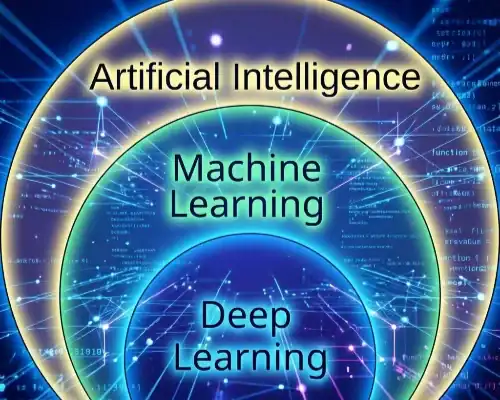
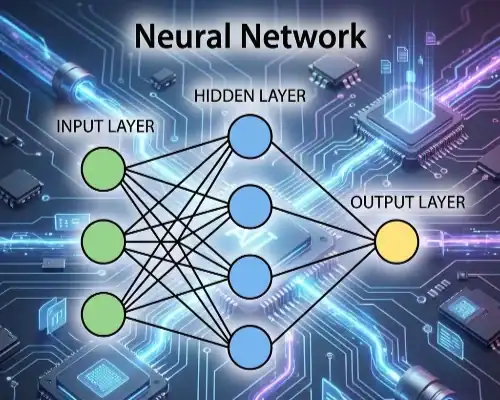
Deep learning is a part of machine learning. Instead of handcrafting features of interest, it relies on deep ANNs to learn from raw signals. Imagine that neural networks replicate your brain. At every layer, information is processed and passed to the next one higher up, and the network learns more complex patterns at each level.
The key difference? Deep learning can be trained on unstructured types of data, like images, texts, or videos, without human input. Recurrent Neural Networks (RNN) work with sequences; the order of any elements matters in a sequence. You see them in speech recognition and language translation.
Types of Deep Learning Models
- Convolutional Neural Networks (CNNs) are extremely popular. Patterns like edges, textures, and shapes are discovered without supervision.
- Recurrent Neural Networks (RNNs) work with sequences; the order of any elements matters in a sequence. You see them in speech recognition and language translation.
- Long Short-Term Memory Networks (LSTMs) excel at time series forecasting, which is a difficult problem both to frame and address with classical models. They’re what drive language models and time series predictions.
- Generative Adversarial Networks (GANs) are capable of generating real-looking images, videos, and even music by pitting two networks against each other.
- Transformers are also the basis of ChatGPT, Google Gemini, and other large language models. They employ self-attention to emphasize the most relevant information.
Deep Learning Applications in 2025
Deep learning powers the most advanced artificial intelligence (AI) applications:
- ChatGPT and AI chatbots
- Self-driving vehicles
- Medical image analysis
- Voice assistants (Siri, Alexa)
- AI-generated art and videos
- Real-time language translation
The catch? These models are computationally extremely expensive and require vast amounts of data as well as powerful GPUs. Deep learning models can cost thousands of dollars to train in computing power.
Key Differences Between Deep Learning and Machine Learning
Let me clear up that confusion with a few examples.
Feature Engineering
Machine learning involves choosing features manually by a human. For predicting housing prices, that could be: square footage, location, and number of bedrooms.
Deep learning learns features automatically from raw data. Show it house pictures, and it sorts out on its own what matters.
Data Requirements
Machine learning does fine when it’s got hundreds or thousands of examples. Great for startups and small businesses.
But deep learning needs millions of data points to achieve optimal performance. If there isn’t enough data, the network will simply memorize training examples instead of learning general patterns.
Computational Power
Machine learning is executed on your everyday CPU. You can train models on your laptop, with no special hardware.
High-end GPUs or TPUs are required for deep learning. Cost management is much easier thanks to cloud services like AWS and Google Cloud.
Interpretability
Machine learning models are transparent. You can at least tell exactly how they are making decisions — essential for finance and health care.
Deep learning functions as a “black box. You know what goes in and you see what comes out, but the middle of it all is a mystery.
When to Use Machine Learning vs. Deep Learning?
Choose Machine Learning When:
| Scenario | Why ML Works Better |
|---|---|
| Limited data (less than 10,000 examples) | ML performs well with smaller datasets |
| Need explainable results | Transparent decision-making process |
| Tight budget | Runs on standard hardware |
| Structured data (spreadsheets, databases) | Optimized for tabular data |
| Quick deployment matters | Faster to implement and deploy |
Choose Deep Learning When:
| Scenario | Why DL Works Better |
|---|---|
| Massive data (millions of examples) | Requires large datasets to perform optimally |
| Images, video, or audio | Excels at unstructured data |
| Maximum accuracy is essential | Achieves higher precision |
| Can afford powerful GPUs | Hardware investment is feasible |
| Interpretability isn’t critical | Black box approach is acceptable |
Pro tip: Plenty of successful companies do both. What they do is use machine learning for structured data tasks, and deep learning for complex pattern recognition.
Frequently Asked Questions: Deep Learning vs Machine Learning
Is deep learning something more than just advanced machine learning?
Which one is easier for beginners to learn?
The Future of AI: What Happens When Artificial Intelligence Plays God
The deep learning boom is feeding on a wealth of unlabeled data. Since Edge AI that explains itself is bringing more transparency to deep learning. Physicists are working to open the black box of deep learning.
The deep learning boom is spreading. Analysts forecast it will hit $279.60 billion by 2032, expanding at a 35% annual rate.
Trends to follow:
AI-based automation is replacing menial and repetitive tasks across all sectors. Customer support, data entry and business of all kinds ever could save time and moneyCustomer support, data entry, and business of all sorts can save time and money.
Edge AI aims to bring machine learning closer to smart devices like smartphones, wearables, and IoT by making these smarter. Now all of those calculations can be performed on your phone without ever having to touch the cloud!
Explainable AI is making deep learning more transparent. Scientists are devising ways to get inside the black box of neural networks.
Energy-efficient models address sustainability concerns. New algorithms have been developed that are less computationally intensive but keep the same accuracy
Wrapping It Up.
Here’s what you need to know:
Machine learning is highly effective for structured data with few examples. It is interpretable, inexpensive, and can be executed on standard hardware.
Deep learning excels with enormous unstructured data sets. It can automatically discover features, but requires powerful GPUs and tons of data.
It depends on your usecase: data size, budget, need for interpretability, and the problem at hand.
Begin with machine learning if you’re new to AI. Once you have the fundamentals down, deep learning gives you the ability to do so many amazing things with image recognition, natural language processing and beyond.
The bottom line? Both technologies are transforming industries. Knowing the differences can help you choose wisely which tool to use for your project.